Gem book Publishers

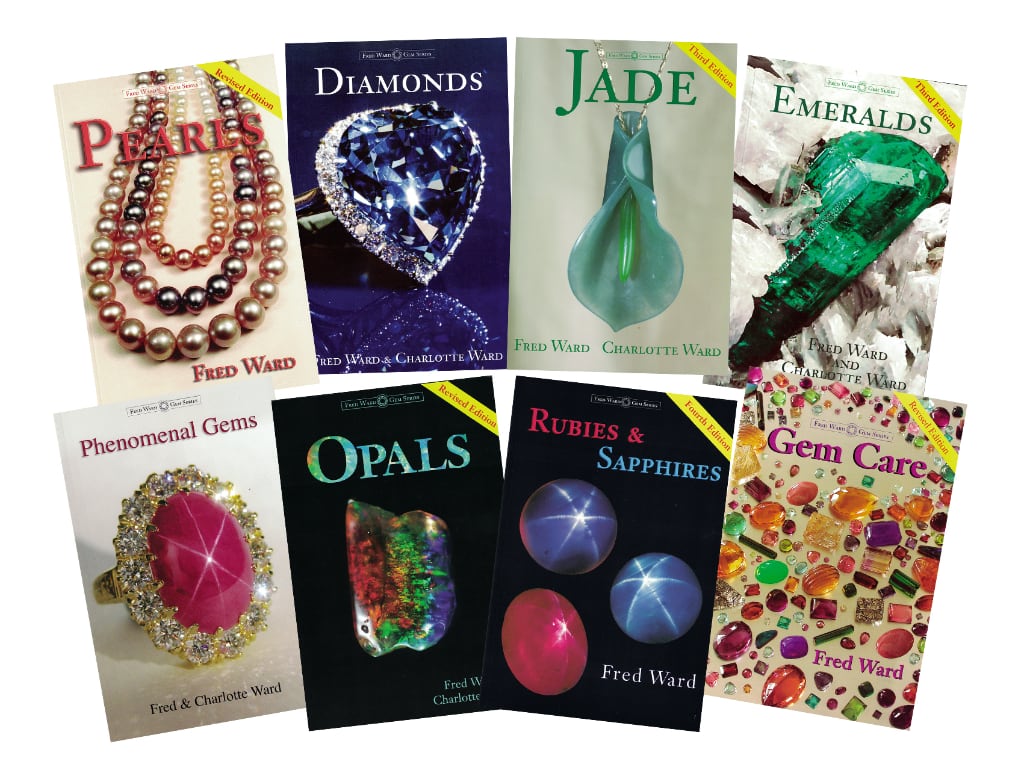
The World’s Most Popular Gem Series

Ordering Information


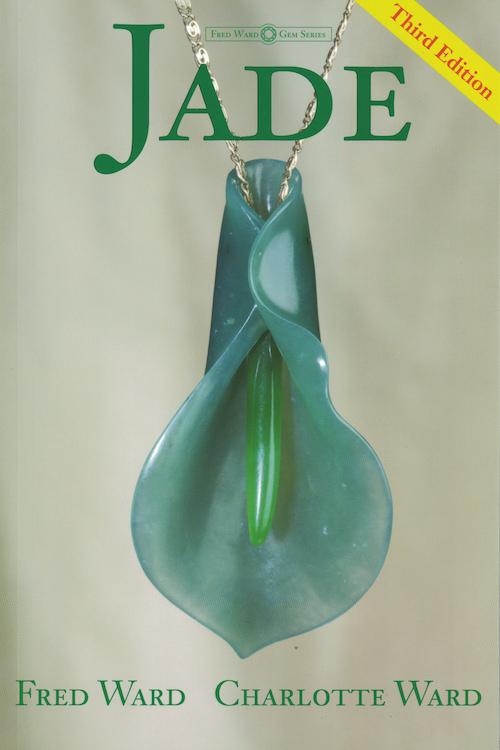
Jade

China’s Stone of Heaven. Two materials with one name - a grand 5,000-year-history as China’s most revered material - and gems often priced higher than diamonds. Jade is all this and more. It has a well-documented history longer than almost any other gemstone. And it has value throughout Asia beyond what most Westerners can appreciate.

For example, the spectacular imperial green jadeite cabochon ring (book cover above), owned by the government of Burma (Myanmar), or the jadeite pendant (left) could easily fetch $250,000 at auction in Hong Kong. When jadeite reaches such levels of color, clarity, and translucency, it sells for as much or more than diamonds or emeralds. Because of historical accidents (all explained in Fred Ward’s new jade book), two totally different materials, nephrite and jadeite, are known to the world as jade.

Nephrite, China’s long revered Stone of Heaven, is also the jade of New Zealand’s Maori (Tiki figures below, right). Used mainly for carving over thousands of years, today’s nephrite is relatively inexpensive, available in a variety of colors, and the toughest material found in nature. China built its culture around nephrite. The emperor spoke to heaven (or God) using a jade disc. A contest’s first-place winner received jade; gold went to second place. Confucius equated the qualities of nephrite to the qualities of a scholar and a gentleman. Typical of Chinese artistic carvings throughout the ages is this winged unicorn (below, left) from the Qing Dynasty.

Many exciting nephrite objects are made from the newly discovered unprecedented deposits in Canada’s British Columbia, now the world’s largest jade supplier. Much of the nephrite becomes beads and cabochons for inexpensive jewelry. But there are numerous exciting possibilities, such as jade tables (right), bookends, and other very large objects. Single-piece jade tables are ideal: beautiful, hard, tough, and trouble-free, each with multicolored patterns that resemble NASA satellite imagery. Contact Fred Ward for more details.

Jadeite is a relative newcomer to the world’s jewelry scene, but is almost universally what people think of when they hear the word “jade.” Historically, Mesoamerican cultures, Mayan, Olmec, Aztec, Toltec, and Zapotec, regarded jadeite as their most precious material. They fashioned their finest masks and elaborate stone carvings from jadeite. In the late 18th century the Burmese discovered jadeite and introduced it to China, and thus to the world. China’s imperial court was enthralled with jadeite”s brilliant colors and superb polish. Almost instantly jadeite, which was used for both carvings and for jewelry, surpassed all other things as objects of desire.

Usually we think of jadeite as green, a green that can rival emerald”s green. But like nephrite, jadeite also comes in a variety of colors, from black to red, orange, yellow, lavender, white, as well as all the green hues. Bright, clear, intense green jadeite is the most expensive of all jade. Fine Burmese jadeite, cut in China or Hong Kong, finds its most receptive market in Asia. The second most expensive color is a bright, deep lavender, such as these earrings and pendant (right). All collectors seek the unusual. There is even a unique jadeite named “Galactic Gold,” a new find in Guatemala (left). Careful chemical analysis has revealed that this rich black material is laced with colorful precious metal inclusions.

The 64-page all-color Jade book is US$14.95, plus $3.00 shipping and handling.


Gem Book Publishers 2575 Barrymore Dr. Malibu, CA 90265 USA Tel 310-456-9949 Fax 310-456-9799

All photographs, text, and code appearing on the Gem Book Publishers website are the exclusive property of Fred Ward and are protected under United States and International Copyright Laws. Photographs, text and code may not be reproduced, copied, stored, or manipulated in any form without the written permission of Fred Ward. This includes use of any image as part of another photographic concept or illustration. No image or any part of this site is within public domain.

All images and text displayed here are owned and copyrighted by © Fred Ward 2010. All rights reserved. Website design by Twelve : Twenty Four